Cornish Pasties
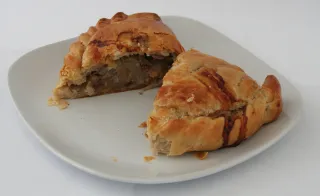
Golden, hand-held pastries filled with beef, potato, swede (rutabaga) and onion, seasoned simply with salt and pepper and baked until the filling is tender.

The pasty is the signature dish of Cornwall in the far southwest of England, where it fed generations of tin and copper miners. Its thick, crimped crust made it a complete meal that could be carried underground and eaten by hand. A traditional Cornish pasty, which has protected status in the UK, is filled with raw diced or sliced beef, potato, swede and onion, seasoned only with salt and pepper and baked so the juices make their own gravy inside the pastry.
Why this recipe works
- A sturdy pastry. A dough made with a mix of butter and lard, and bread flour, is strong enough to hold a heavy filling without cracking, yet still flaky.
- Raw filling. Everything goes in raw. As it bakes, the beef and vegetables steam in their own juices and create a peppery gravy.
- Thin, even pieces. Slicing the vegetables thinly means they cook through in the same time as the beef.
- Plenty of pepper. Generous black pepper is the classic seasoning.
What is swede?
Swede is the British name for rutabaga, a large, yellow-fleshed root vegetable. In Cornwall it is often called turnip. If you cannot find it, use turnip or more potato.
How to crimp a pasty
Fold the pastry over the filling, press the edges together, then starting at one end, fold a small piece of the edge over itself and press down. Repeat along the edge to make a rope-like pattern of 20 or so crimps. Tuck the ends under.
FAQ
Can I use store-bought pastry?
Shortcrust pastry works, though it is more fragile. Roll it a little thicker. For another savory pie, see our chicken pot pie.
Cornish Pasties
Ingredients
For the pastry
For the filling
Conversions are rounded for convenience. For baking, use the original measurements where possible.
Instructions
Make the pastry
-
Whisk the flour and salt. Rub in the butter and lard until the mixture looks like coarse breadcrumbs with a few larger pieces.
-
Add the ice water and mix with a knife until the dough comes together, adding more water if needed. Knead briefly until smooth.
-
Wrap and chill for at least 1 hour.
Fill and bake
-
Heat the oven to 400°F (200°C, or 180°C (355°F) fan, gas mark 6). Line a large baking sheet with parchment paper.
-
Divide the pastry into 6 pieces. Roll each into an 8-inch (20 cm) circle about ⅛ inch (3 mm) thick.
-
On one half of each circle, layer some potato, swede, onion and beef, seasoning each layer generously with salt and pepper. Finish with more potato and a few pieces of butter.
-
Brush the edge with water, fold the pastry over to make a half-moon and press to seal. Crimp the edge and place the pasties on the sheet.
-
Brush with beaten egg and cut a small steam hole in the top of each.
-
Bake for 20 minutes, then reduce the oven to 325°F (160°C, or 140°C (285°F) fan, gas mark 3) and bake for 30 to 35 minutes more, until deep golden. The filling should be tender when tested with a skewer through the steam hole.
-
Cool for 10 minutes before eating.
Notes
- Pasties are traditionally eaten warm or at room temperature, by hand, starting from one end.
Tips
- Chill the assembled pasties for 15 minutes before baking to help them keep their shape.
Substitutions
- All butter: use 1 cup (226 g) butter instead of butter and lard; the pastry will be slightly less sturdy.
- Vegetarian: replace the beef with diced cheese and extra vegetables, such as carrot and leek.
Storage and reheating
- Refrigerate for up to 3 days and reheat at 350°F (175°C) for 15 to 20 minutes.
- Freeze baked pasties for up to 3 months.
Reviews
No reviews yet. Made this recipe? Be the first to share how it went.
Leave a review
You might also like

Pies & Casseroles
Fish Pie

Around the World
Chicken Enchiladas Verdes

Pies & Casseroles
Classic Lasagna

Around the World